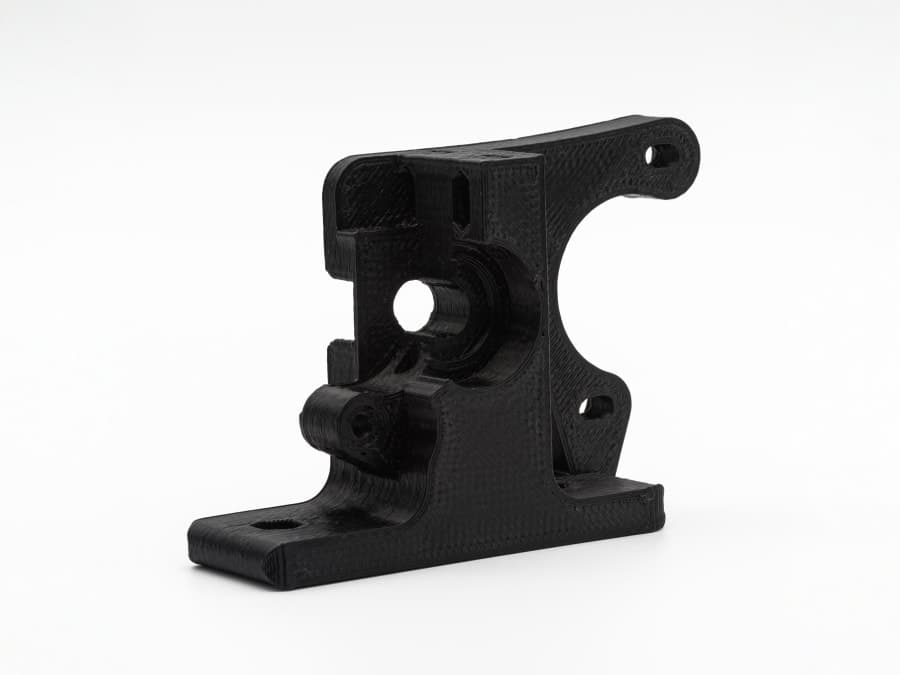
Carbon Fiber FDM Nylon
Composites
Wear resistantFunctionalImpact resistantChemical resistant
Carbon fiber nylon blends standard nylon (polyamide) with chopped carbon fiber, substantially increasing stiffness and tensile strength while raising heat resistance well above standard nylon – often into the 150-170 °C range compared to roughly 120 °C for unreinforced nylon. This comes at a real cost to toughness: Standard nylon is known for high impact resistance and the ability to bend significantly before failing, while carbon fiber nylon is notably more brittle and prone to cracking under impact, even though it's stiffer under normal loading. Like other nylons, it gradually absorbs moisture from the air, which can shift its mechanical properties somewhat over time in humid environments. It also resists many oils, alcohols, and bases. Carbon fiber nylon is a good choice for drone frames, dimensional jigs, and stiff structural brackets where rigidity and heat resistance matter more than impact resistance.
Available finishes
Each finish can be combined with the available colors at checkout.

Standard
3 colorsThe standard (as-printed) finish on FDM parts shows the natural texture of layer-by-layer printing. The visibility of the layer lines depends on part geometry and orientation, plus light marks where support material was removed.

Sanded
3 colorsThe sanded finish on FDM parts reduces the visibility of layer lines compared to the standard finish, though some surface texture generally remains. How much smoothness is achieved can vary depending on the material.